 MealSaid
A simpler Cronometer alternative: I counted the steps
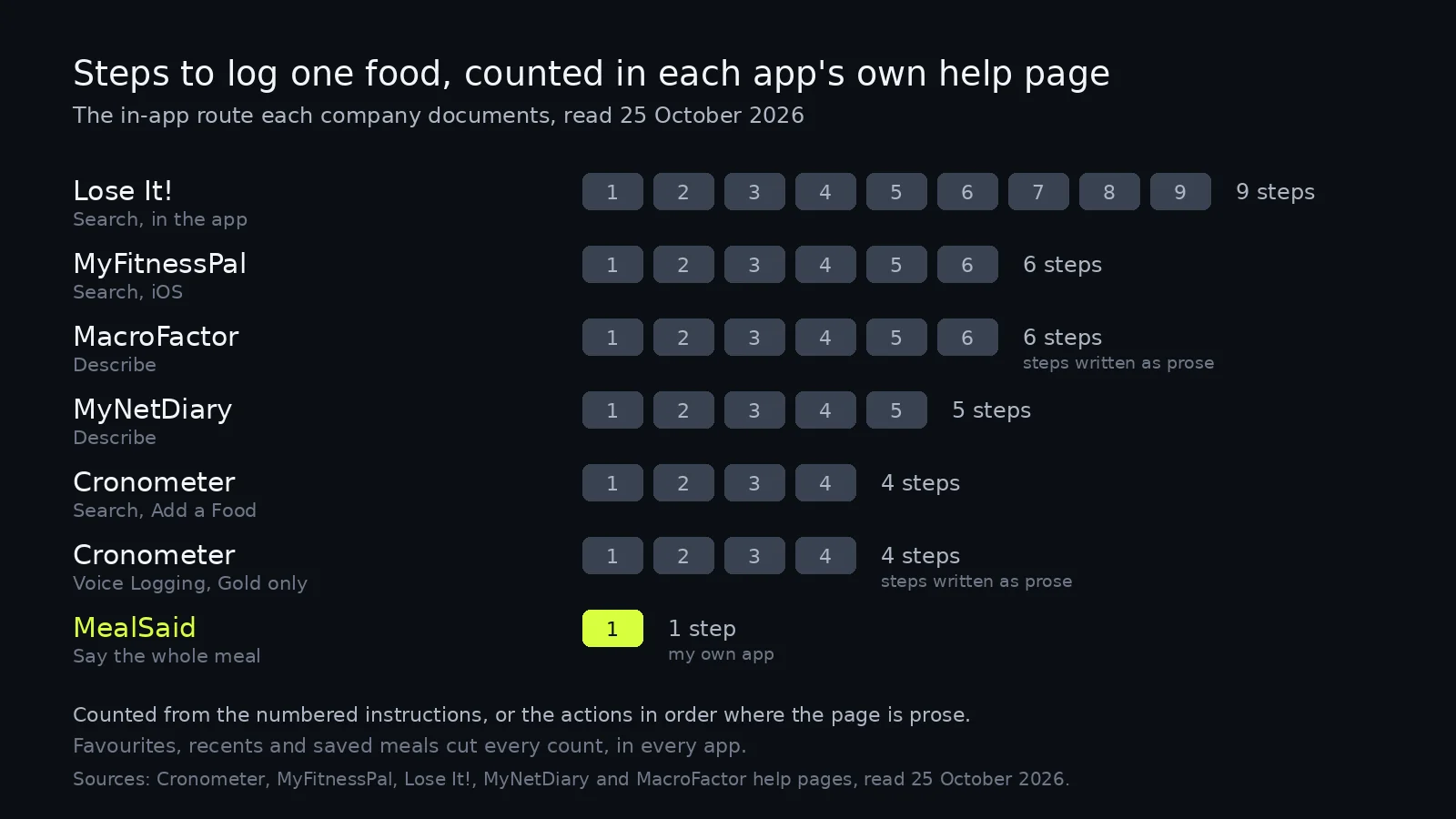
Cronometer's own help page lists 4 steps to log a food, Lose It lists 9. Five simpler alternatives with prices and step counts, checked 25 Oct 2026.
On this page
Cronometer's own instructions for logging one food are four steps long, shorter than MyFitnessPal's six and Lose It's nine. The simpler swap most people are looking for is MyNetDiary, whose core version is "free and ad-free", tracks 108 nutrients and takes a spoken sentence in five published steps.
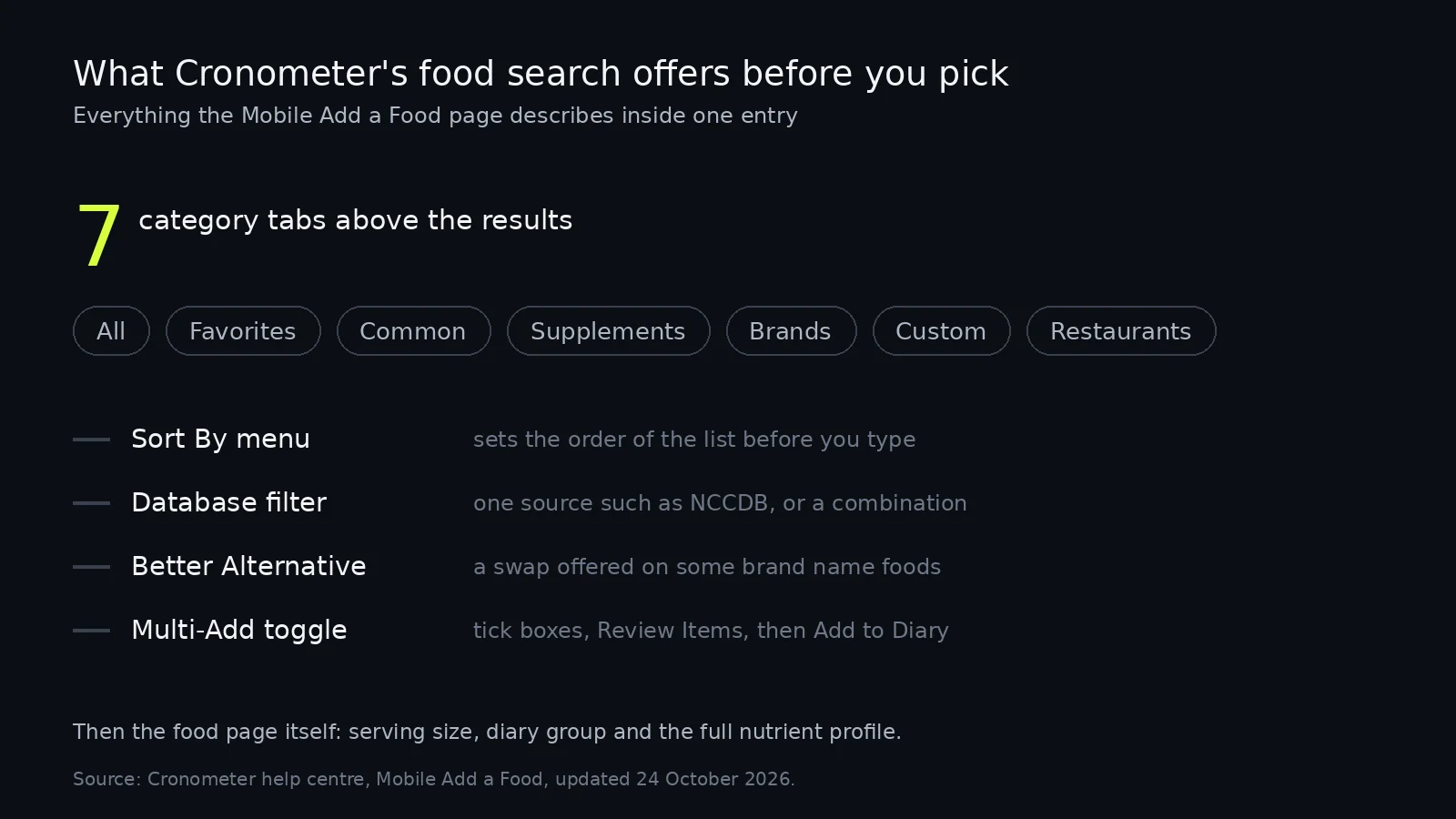
The weight in Cronometer sits inside those four steps: seven category tabs, a Sort By menu, a database filter and a Better Alternative swap, all described on the same help page.
Cronometer has its own fast route, a spoken sentence, and it costs $59.99 a year.
I read five help centres and four App Store listings on 25 October 2026 and counted the steps each company publishes. I build a calorie tracker, so treat the second to last section as the biased one.
How many steps does Cronometer take to log one food?
Four, by its own count: tap the plus icon, tap Add Food, type the name, tap the food to open serving size and diary group.
That is the whole numbered list on Cronometer's Mobile Add a Food page (Cronometer, updated 24 October 2026).
MyFitnessPal publishes six steps for iOS (MyFitnessPal, updated 23 October 2026). Lose It publishes nine (Lose It!, updated 25 August 2026).
So on the published numbers, Cronometer is already the short one. I went in expecting the opposite and had to redo the chart.
So why does Cronometer feel slow?
Because step three hides a screen full of decisions, and the page documents every one of them.
The food search carries seven category tabs: All, Favorites, Common, Supplements, Brands, Custom and Restaurants. Above them sits a Sort By menu and a database filter that can be pointed at one source such as NCCDB or a combination.
Some brand foods are then tagged with a Better Alternative, a curated swap with fuller data, and a Multi-Add toggle turns the list into tick boxes with a Review Items step (Cronometer).
Every one of those is there for a reason. Cronometer even keeps a Crono-Hacks page for people who want more of this, with recipes built out of daily supplements and custom biometrics for nutrients it does not track (Cronometer, updated 4 October 2026).
That is a nutrition instrument. If you want one, nothing below replaces it.
Which app asks you for the least?
MyNetDiary, once you use its Describe box: five published steps, on a tier that is free and ad-free.
| App | Steps in its own instructions | Free tier | Whole spoken meal | Price for that route |
|---|---|---|---|---|
| Cronometer | 4, search | Yes, ads, up to 95 nutrients | Voice Logging, Gold only | $59.99 a year |
| MyNetDiary | 5, Describe | Yes, no ads, 108 nutrients | Describe, 3 free tries then Premium | $59.99 Premium |
| MyFitnessPal | 6, search | Yes, ads | Voice Log, Premium only | $79.99 a year |
| MacroFactor | 6, Describe, written as prose | No, 7 day trial | Describe, any paid plan | $71.99 a year |
| Lose It! | 9, search | Yes, Basic | No, Say It finds one food | $79.99 a year |
| MealSaid | 1, say the meal | Free, no purchases | Yes | Free |
Four notes on that table. A step in a help page is not a tap on a phone, and favourites, recents and saved meals shorten every one of these counts.
Free means with ads in two cases. Cronometer puts "No Advertisements" on its Gold list (Cronometer, updated 24 October 2026), and MyFitnessPal says plainly that ads pay for its free core (MyFitnessPal, updated 15 September 2026).
Apple also never says what period MyNetDiary's $59.99 Premium purchase buys, so that row is the one price here I cannot date to a billing cycle.
MacroFactor calls its logger the "fastest food logger on the market" and writes its instructions as prose rather than a numbered list, so its six is my count of the actions in order (MacroFactor).
Can you just talk to Cronometer instead?
Yes, and both voice routes sit behind Gold at $59.99 a year.
The help page is blunt about it: "Gold users can take advantage of our AI Voice-Logging feature". You open the orange plus menu, describe the food, tap Match Foods, then tap Add To Diary (Cronometer, updated 24 October 2026).
The Siri route is the one to read before you buy. Cronometer's own getting started list runs to eleven sub-steps across three stages: install Shortcuts, enable Siri on the Cronometer shortcut, then turn on voice activation in iOS Settings (Cronometer, updated 24 October 2026).
MyNetDiary's Describe costs nothing for the first three tries, then needs Premium, and it is five steps including the review (MyNetDiary, updated 21 October 2026). Our post on what each voice feature actually means has the rest.
What do you lose by leaving Cronometer?
The data quality, and most of your history.
Cronometer's free Basic account already covers up to 95 nutrients, over a million food entries and unlimited barcode scanning (Cronometer). MyNetDiary's free tier matches it on nutrient count, at 108.
What it does not match is the bookkeeping. Cronometer shows a Data Confidence figure on a nutrient target, because a branded food often carries only the fifteen or so values a US label requires (Cronometer, updated 16 October 2026).
Then there is the history. MyNetDiary's own migration page tells you to move Cronometer data through Apple Health, and lists weight, exercise and other health data (MyNetDiary, updated 3 August 2025). Your food diary is not on that list.
If depth is why you are on Cronometer, read our MacroFactor and Cronometer comparison before switching to anything.
Which one would I use?
MyNetDiary, if I wanted a database and a free account. Mine, if I wanted the meal logged and forgotten.
MealSaid is the narrow option here. You say the whole meal and it writes calories, protein, carbs, fat and fiber to Apple Health, and at times you pick your phone rings and a voice asks what you ate.
What it does not do is most of this post. No barcode scanner, no food database to search, no photo logging, no micronutrients beyond those five fields, iPhone only on iOS 26, English only.
Anyone who tracks vitamins, minerals or a medical diet should stay on Cronometer. The case for a simpler app is for people whose diary is empty by Thursday, which is the failure mode the research keeps finding.
How I checked this
Checked 25 October 2026. I read eleven pages for the step counts: Cronometer's Add a Food, Voice Logging, Siri Voice Logging and Crono-Hacks articles, MyFitnessPal's logging article, Lose It's logging and pricing articles, MyNetDiary's Describe and free tier pages, and MacroFactor's two logging articles.
Prices came off each US App Store listing on the same day, where Cronometer shows Gold Annual at $59.99 and Gold Monthly at $10.99. Apple lists at most ten purchases per app, so treat those as a floor rather than a full price list.
The step counts are counts of published instructions, not timed runs on a phone. My own timed test across six apps is still unpublished, so MealSaid's one step in the table is a description of the flow and not a measurement. The Cronometer, MyFitnessPal and Lose It help centres return 403 to scripts, so those articles were read through each help centre's public API and the updated dates are the ones the API reports. Corrections to ohmbrock42@gmail.com.
Questions
What is a simpler alternative to Cronometer?
MyNetDiary, if you want to keep a free account and a food database. Its core version is free and ad-free, tracks 108 nutrients and includes barcode scanning and Siri on iPhone.
Is Cronometer hard to use?
Its logging instructions are short, four steps on its own help page. The weight sits inside those steps, where the same page describes seven category tabs, a Sort By menu and a database filter.
Can I log food in Cronometer without typing?
Yes, with Gold at $59.99 a year. Voice Logging and the Siri phrase are both Gold features, and the Siri route needs eleven setup steps first.
Which calorie app takes the fewest steps to log a meal?
Counting the steps each company publishes, MyNetDiary's Describe is five and Cronometer's search is four. MealSaid is one sentence, and it is my own app, so weigh that.
Will I lose nutrient detail if I leave Cronometer?
Not necessarily on count. Cronometer tracks up to 95 nutrients and compounds, MyNetDiary says 108, though only Cronometer shows a Data Confidence figure telling you how much of a nutrient target its database could actually account for.