 MealSaid
Calorie tracker for ADHD, counted by decisions per meal
No app treats ADHD. Logging one food takes 6 choices in Lose It, 5 in MyFitnessPal, 4 in Cronometer and 1 if you say the meal out loud.
On this page
There is no calorie tracker built for ADHD, and no app is a treatment for it. What an app can change is the number of decisions one entry costs, and that varies more than the marketing does: logging a single food takes six choices in Lose It, five in MyFitnessPal, four in Cronometer, and one if you say the whole meal out loud.
I counted those from each company's own help page on 26 October 2026. Then I read the research on why decisions, rather than taps, are the part that breaks.
One thing up front. The research below is about populations, not about you, and none of it shows that ADHD causes anything about weight.
Is there a calorie tracker made for ADHD?
No, and I would be wary of one that said it was. None of the apps I checked claims a clinical result, and none has been tested in an ADHD population.
What you can compare is friction, and four things carry most of it.
- How many separate choices one entry costs.
- Whether anything reaches you before the meal is forgotten.
- Whether a missed day or a bad number punishes you when you open the app.
- Whether you can log at 11pm for a lunch that happened at 1pm.
The numbers below cover the first two, which are the ones I could count from documents.
What does the research show about ADHD and eating?
A steady association with weight, a stronger one with eating disorders, and no evidence of cause in either direction.
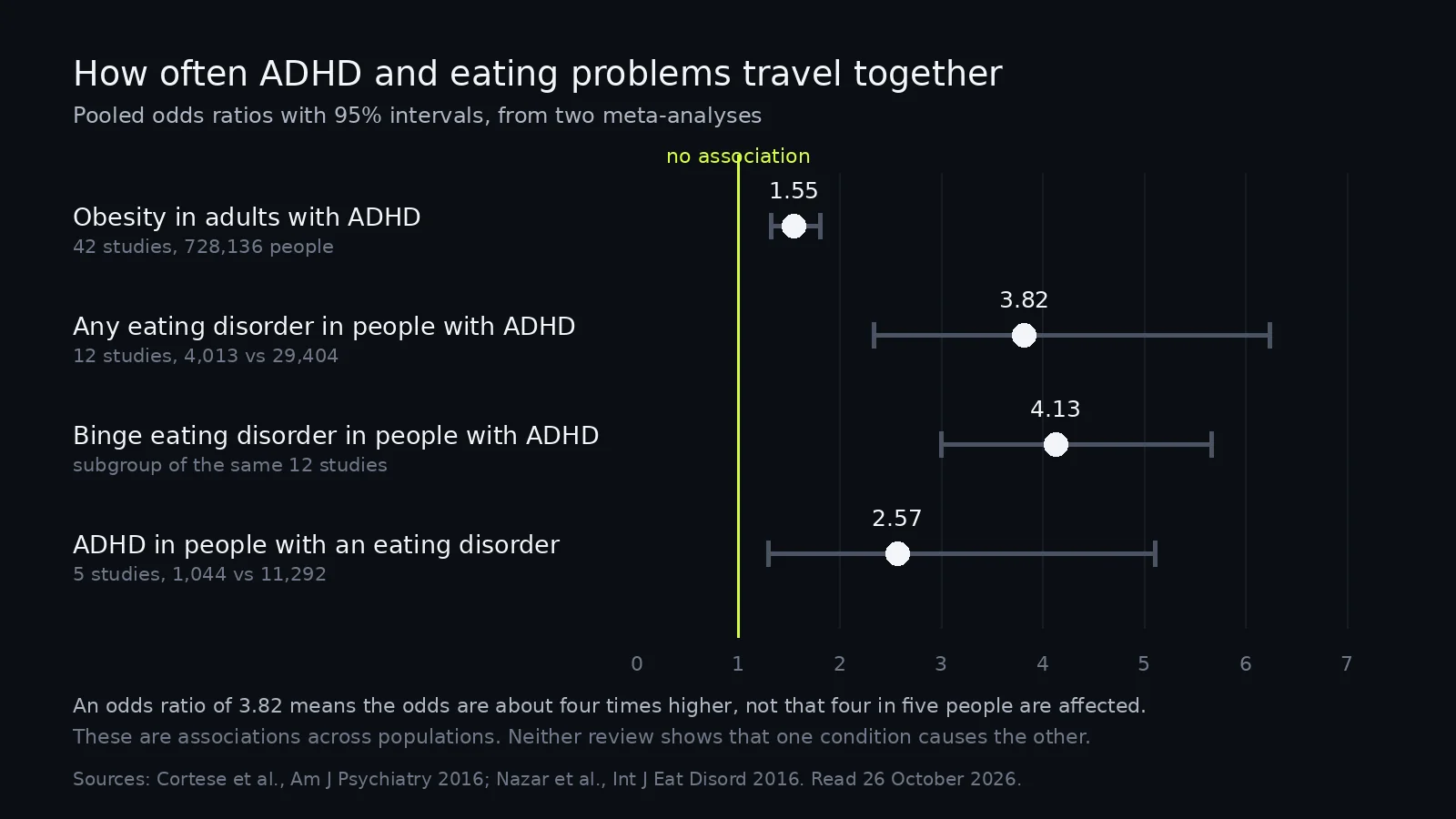
The obesity figure comes from Cortese and colleagues, who pooled 42 studies covering 728,136 people. For adults the odds ratio was 1.55 (95% CI 1.32 to 1.81), and pooled obesity prevalence was 28.2% in adults with ADHD against 16.4% in those without (Am J Psychiatry 2016).
The same review reports that "individuals medicated for ADHD were not at higher risk of obesity", which is a useful brake on any story that treats this as a willpower gap (Am J Psychiatry 2016).
The eating disorder numbers are larger and matter more for how you use a tracker. Nazar and colleagues pooled 12 studies (4,013 people with ADHD against 29,404 controls) and found odds of 3.82 for any eating disorder, 4.13 for binge eating disorder, and 2.57 the other way round in 5 studies of eating disorder cohorts (Int J Eat Disord 2016).
That is my reason for saying something uncomfortable about my own category. If counting makes you restrict, a calorie app is the wrong tool, and the odds above say that applies to more people here than average. For scale, the CDC estimated 15.5 million US adults (6.0%) had a current ADHD diagnosis in 2023, from 7,046 interviews (MMWR, 10 October 2024).
How many decisions does one food entry take?
Six in Lose It, five in MyFitnessPal, four in Cronometer, one if you say the meal.
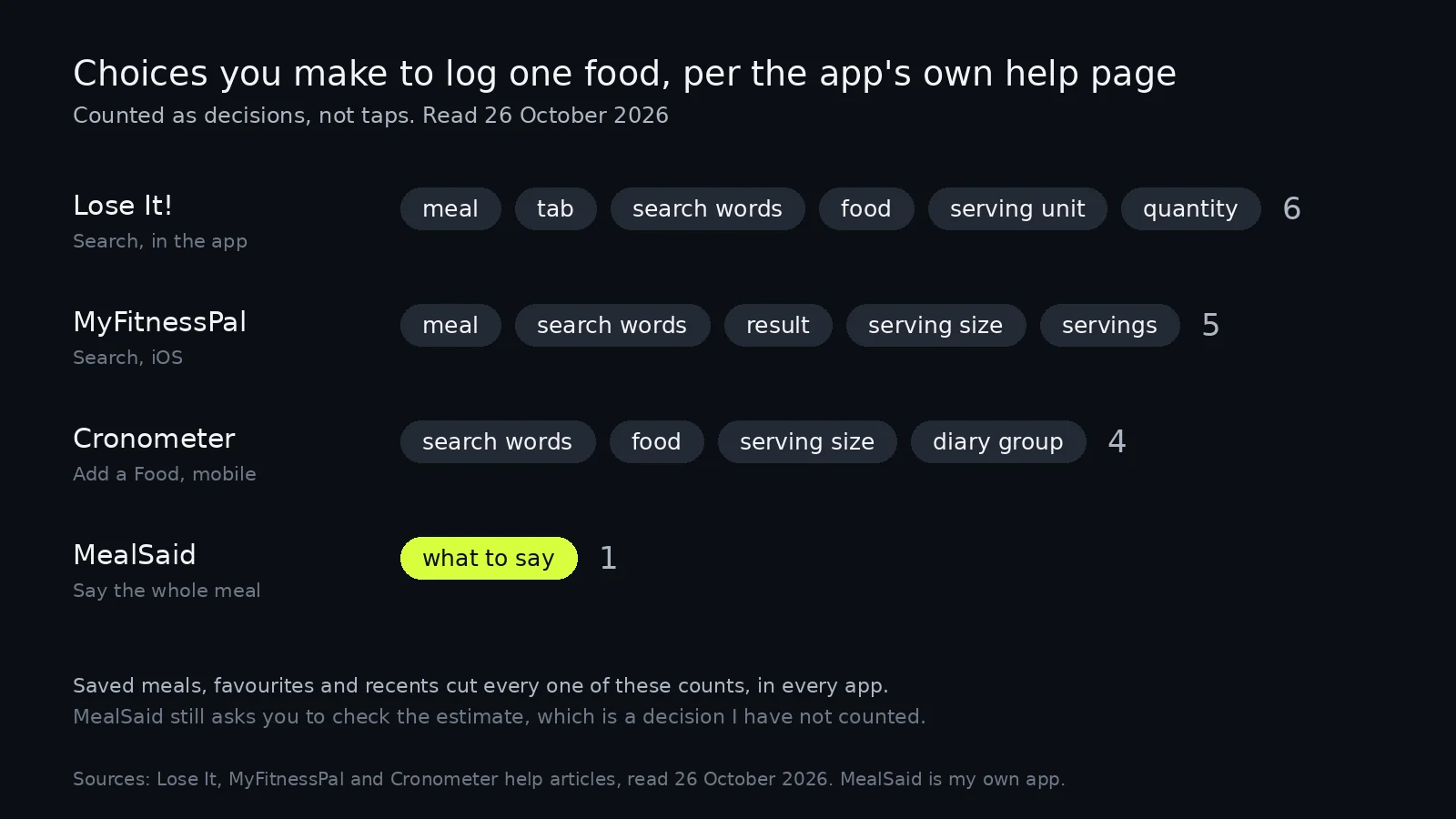
I counted a decision as any point where the app's own instructions ask you to pick between alternatives for this one food. Tapping a fixed button is not a decision. Picking which search result is your yoghurt is.
Lose It's article runs meal, tab (Search, My Foods, Meals or Recipes), search words, food, serving unit, quantity (Lose It help, updated 25 August 2026).
MyFitnessPal's runs meal, search words, result, serving size, number of servings (MyFitnessPal help, updated 23 October 2026).
Cronometer is the lightest of the three at four, because meal and quantity live on one screen: search words, food, serving size, diary group (Cronometer support, updated 25 October 2026). Cronometer does this better than the two bigger apps, and it is free for that route.
This is a different count from the one in my post on Cronometer's step list, which counted steps. Steps include the taps you do on autopilot. Decisions are the ones that need your attention back on the meal.
Why do decisions matter more than taps?
Because every decision asks you to hold the meal in mind while you answer something else. Lose the thread between "chicken burrito" and "which of these burritos", and the entry does not happen.
Cordeiro and colleagues surveyed 141 food journalers (47 active, 94 lapsed) alongside 5,526 forum posts. Their line on missed entries is blunt: "Simply forgetting to journal is a major barrier", and it was the most cited reason respondents had missed at least one. Asked what made journaling hard, 31 called it too much effort, 27 called it time consuming and 16 called it tedious (CHI 2015).
The same paper describes the other failure: people who had a bad day stopped opening the app, because red numbers read like a verdict. No app I checked lets you turn that off.
| Study | Who | What it found | Link |
|---|---|---|---|
| Cordeiro et al., 2015 | 141 journalers, 47 active and 94 lapsed, plus 5,526 forum posts | Forgetting was the most cited reason for a missed entry; 31 respondents called journaling too much effort | CHI 2015 PDF |
| Patel et al., 2022 | 38 adults randomized, 18 detailed and 20 simplified, 3 month program | Simplified logging got 97% of days against 49%, with the same weight loss (3.3 kg vs 3.4 kg) | JMIR Form Res |
| Chen et al., 2024 | 30 people, 4 weeks, each person tried both prompt types, Android | Context triggered prompts: 21.77% logged within an hour against 17.32% for fixed-time prompts | CHI 2024 PDF |
| Cavero-Redondo et al., 2020 | Meta-analysis of 20 studies | Phone based self-monitoring held adherence better than paper at six and twelve months | Nutrients |
Patel's trial is the one that moves me most. Eighteen people logged every food in the Fitbit app and twenty ticked a daily checklist of high calorie foods; median days logged were 49% against 97%, and weight change was the same, 3.4 kg against 3.3 kg (JMIR Form Res 2022). Thirty-eight people is a pilot, not a verdict.
Do reminders fix the forgetting?
Partly, and less than you would hope. Chen and colleagues gave 30 people four weeks of both prompt types, and context triggered prompts were followed by a log within the hour 21.77% of the time against 17.32% for fixed-time ones (CHI 2024).
Read that as the ceiling for a banner. Four in five prompts went unanswered in the better condition, because a notification still asks you to go and do the six decisions. That study ran on Android phones, so treat the size of the gap as a direction rather than a number for iPhones.
MealSaid's answer is to make the interruption harder to dismiss: at times you pick, your phone rings like a normal call and a voice asks what you ate. Whether that beats a banner over a month is exactly the test I have not published yet, and I am not going to claim it until I have. The longer version of the dropout research is in why most people quit calorie tracking.
Where MealSaid is not the answer
It is one sentence per meal and nothing else, which is a feature until it is not.
- No barcode scanner and no database you can browse, so a packaged food you cannot name is a guess.
- iOS 26 and English only, and the phrase needs a connection because the understanding happens on our server.
- It estimates from your sentence. If you want gram-level control and a full micronutrient profile, Cronometer is the better app and I would say so to anyone.
And the thing that no app covers: if logging tips into counting that feels compulsive, stop and talk to a clinician rather than switching apps. The Nazar numbers above are the reason that sentence is in this post.
How I checked this
Checked 26 October 2026. The decision counts come from each company's current help article, read on that date, counting only the choices the instructions name for a single food, and ignoring the shortcuts (saved meals, favourites, recents) that cut every count. The research numbers come from the PubMed abstracts and open PDFs linked above, read the same day, and each one carries its sample size in the table or the sentence.
What I could not do. There is no study of calorie tracking apps in an ADHD population that I could find, so the friction argument here is an inference from general logging research, not a tested claim about ADHD. I also have no adherence data of my own yet; the 30 day comparison of reminders against a scheduled call is running on one person, which is me, and that is a weak design I will label as such when it goes up.
Corrections and better papers to ohmbrock42@gmail.com.
Questions
Is there a calorie tracker made for ADHD?
No app is built or tested for ADHD, and none of the big trackers claims to treat it. The thing to compare is how many choices one entry costs you, which runs from one to six across the apps I counted.
Why is calorie tracking so hard with ADHD?
Every entry asks you to hold the meal in mind while you make four to six separate choices. In a study of 141 food journalers, forgetting was the most cited reason for a single missed entry and effort was the top reason for quitting.
Does ADHD make weight harder to manage?
Population data shows an association. A meta-analysis of 42 studies and 728,136 people pooled obesity at 28.2% in adults with ADHD against 16.4% without, and found no higher risk among those taking medication.
Do reminders fix forgetting to log?
Only partly. A 2024 randomized test found context triggered prompts beat fixed-time ones, 21.8% against 17.3% of prompts followed by a log within the hour, so most prompts were still ignored.
Which tracker should I pick if I hate logging?
Pick the one with the fewest decisions you will actually repeat. Cronometer is the lightest of the database apps at four, and a voice-first app such as MealSaid asks for one sentence but gives you no database to browse.