 MealSaid
Why most people quit calorie tracking within two weeks (what the research says)
Seven studies on food-logging dropout, with numbers and links. 2.58% of 189,770 downloads stayed active. Simplified logging got 97% of days versus 49%.
On this page
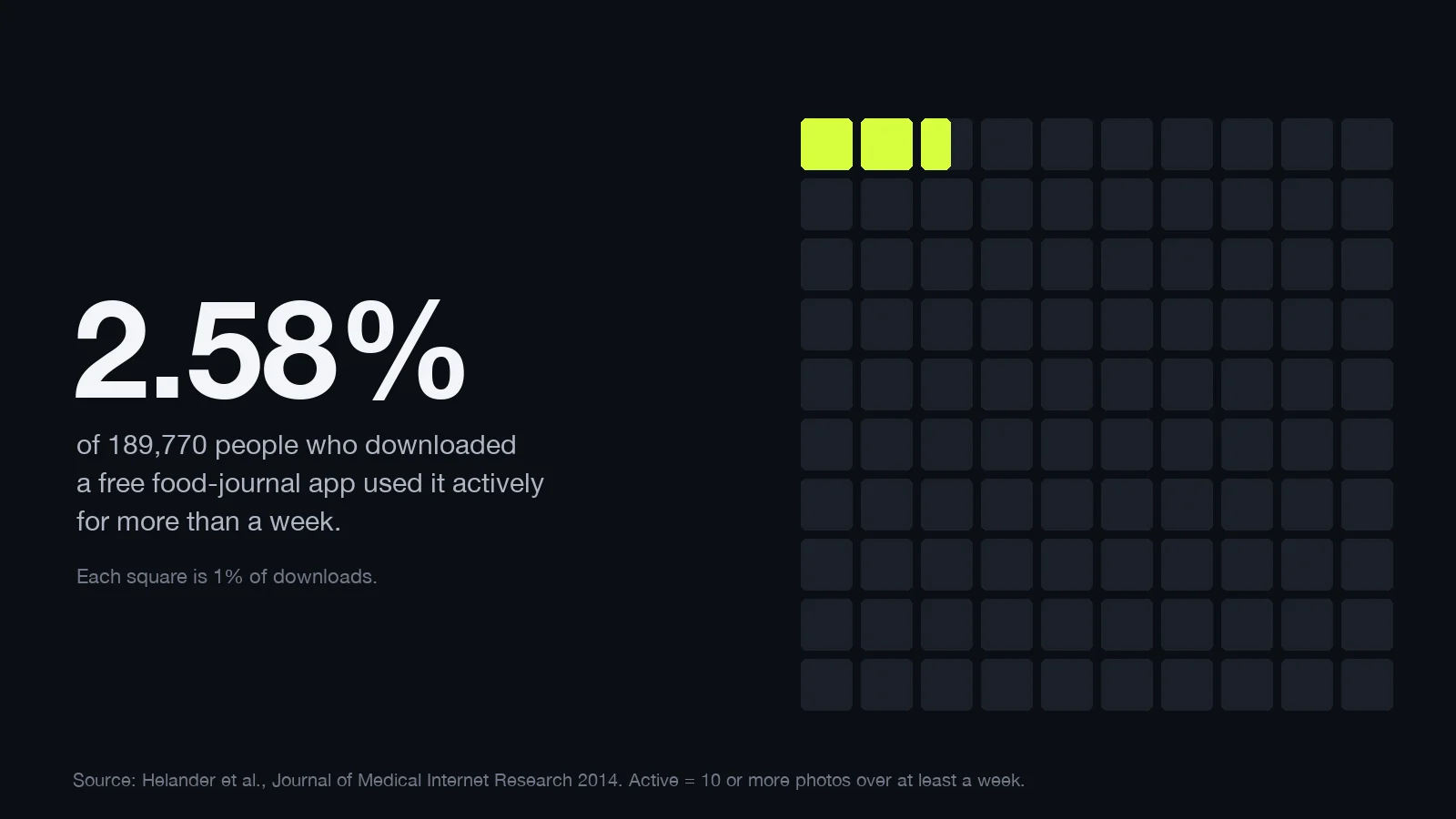
Most people stop logging food within a few weeks, and the research says the reasons are effort and forgetting, not motivation. The cleanest number: of 189,770 people who downloaded a free food-journal app, 2.58% used it actively for more than a week (Helander et al., 2014). In a six-month MyFitnessPal trial, 84% of those who quit or cut back gave one reason: tedious (Laing et al., 2014).
I read these papers because I was about to build another tracker and wanted to know what kills them. Every number links to its source with the sample size. Checked 20 October 2026.
How many people actually keep logging?
Almost nobody, past the first week. The best large-scale number is 2.58%; the best trial number is a fall from 97% to 35% of participants logging in between month one and month six.
The Eatery was a free iPhone app that logged meals by photo. Helander and colleagues had the data for every download between October 2011 and April 2012: 189,770 people used it at least once. "Active" meant ten or more photos and at least a week of use.
Result: "only 2.58% (4895/189,770) used the app actively". Another 11% were semi-active and 86% never took a valid photo (J Med Internet Res 2014).
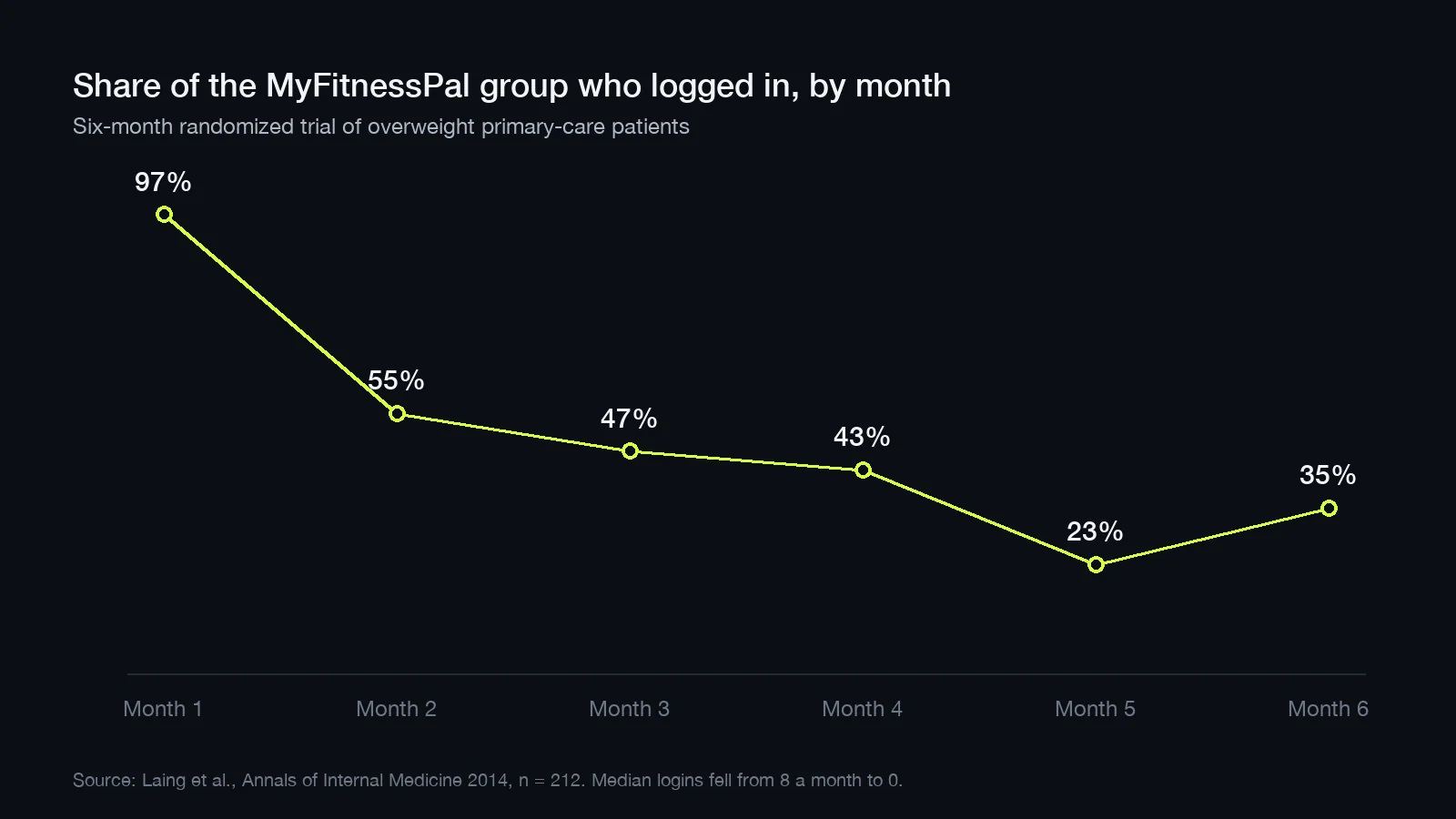
The MyFitnessPal trial is the one people misquote, including me until this week. Laing and colleagues randomized 212 overweight primary-care patients, half to MyFitnessPal. Logins in the app group ran 97% in month one, 55% in month two, then 47%, 43%, 23% and 35% in month six; median logins went from 8 a month to zero. Weight loss was no different from usual care.
At six months 80% said they planned to keep using the app, a number I had inverted in my notes as "20% would continue". The honest reading is worse: most said they would continue, and most did not (Ann Intern Med 2014).
The reviews agree on the shape. Burke, Wang and Sevick's review of 22 self-monitoring studies describes "a gradual decline in self-monitoring adherence" wherever it was measured over time, with one study where only 25% were still logging at the end (J Am Diet Assoc 2011).
Goldstein and colleagues measured dietary logging in a coached 12-week program at 92.7%, 94.9% and 86.7% by month, and found it "decreased significantly over time for eating and weight" (Obes Sci Pract 2020). That is with coaching; the free-app curve above is without.
Industry numbers are rougher. Adjust's benchmark has Day 7 retention at 13% and Day 30 at 7% across all app categories, and health and fitness at 27% on Day 1 (Adjust). I could not trace the "health apps keep 12 to 16% at Day 7" figure that circulates in blog posts to a primary report, so I am not repeating it.
Why do people stop?
Effort first, forgetting second, social situations third, in every study that asked.
| Study | Who | Finding | Link |
|---|---|---|---|
| Cordeiro et al., CHI 2015 | 141 food journalers (47 active, 94 lapsed) plus 5,526 forum posts | Top lapse reasons were "too much effort" (31 respondents), "time-consuming" (27), "tedious" (16). Forgetting was the most-cited reason for individual missed entries. 22 of 94 lapsed said they no longer needed to journal. | |
| Laing et al., 2014 | 212 patients, MFP vs usual care, 6 months | Of 58 who stopped or reduced use, 84% said tedious, 28% too busy or stressed. Logins 97% in month 1, 35% in month 6. | PMC |
| Helander et al., 2014 | 189,770 downloads of a photo food journal | 2.58% active beyond one week. | PMC |
| Patel et al., 2022 | 38 adults, 84 days, detailed vs simplified logging | Median days logged: 49% detailed vs 97% simplified. Weight loss 3.4 kg vs 3.3 kg. | PMC |
| Bentley and Tollmar, CHI 2013 | 10-user pilot then 60-user study | Logging frequency 12% without notifications, 63% with. Observational, not randomized. | Abstract |
| Chen et al., CHI 2024 | Randomized, weight maintenance app | Context-triggered notifications: 21.77% logged within 60 minutes vs 17.32% for fixed-time ones. | |
| Goldstein et al., 2020 | 12-week digital program | Dietary logging adherence 92.7%, 94.9%, 86.7% by month, declining significantly. | PMC |
Cordeiro's paper is the one to read. It is qualitative, so the counts above are respondents, not percentages, but it names the mechanism: every entry costs a search, a portion guess and a decision, and people forget until the moment has passed.
"Simply forgetting to journal is a major barrier to reliable journals". Lapsers also felt judged by red numbers after a bad day and stopped opening the app, the "negative nudge" in the title.
Does making logging simpler actually help?
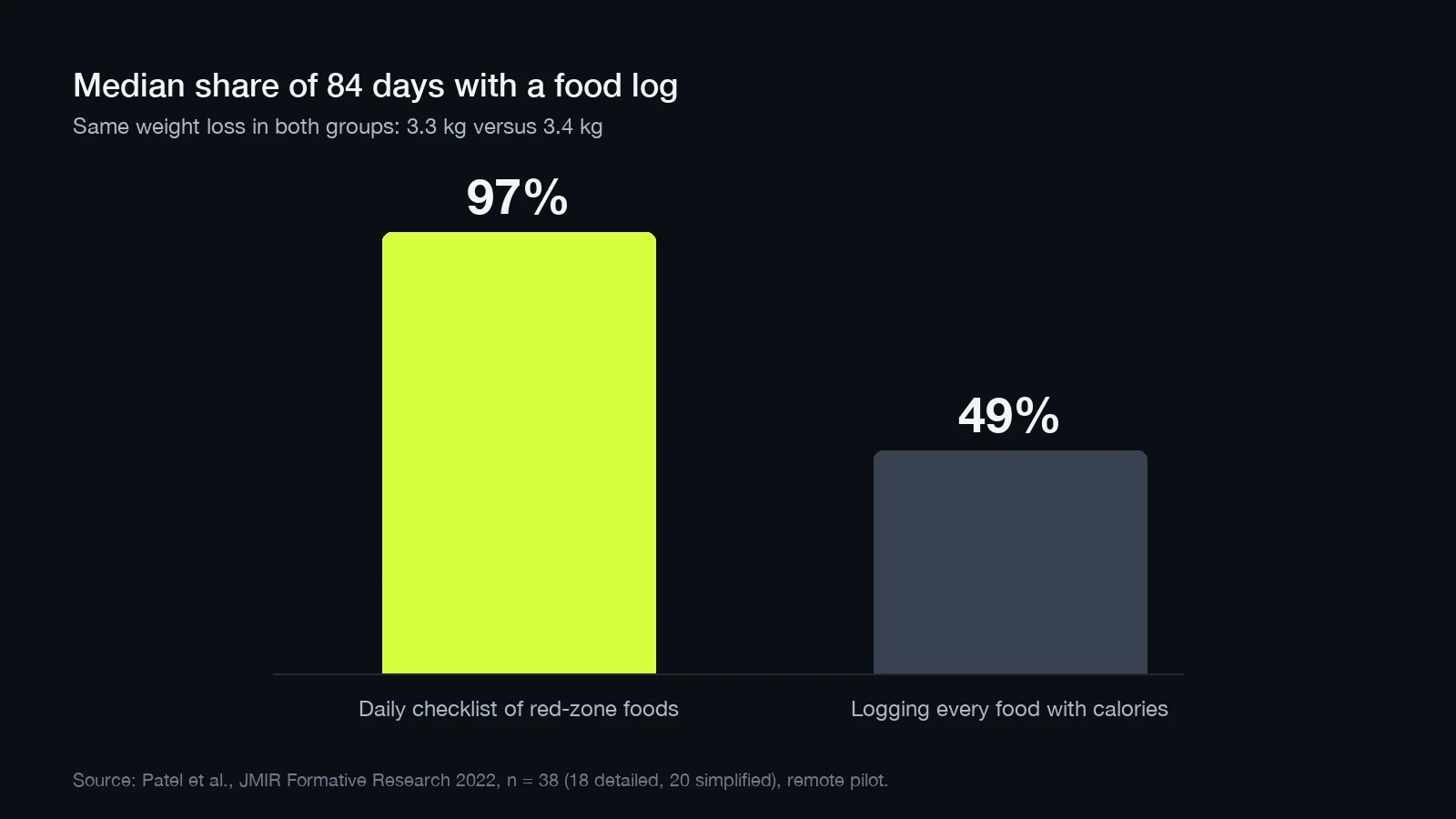
Yes, in the one randomized test I could find, and by a lot: 97% of days logged versus 49%, with the same weight loss.
Patel and colleagues ran a fully remote pilot with 38 adults over 84 days. Eighteen logged every food in the Fitbit app. Twenty used a daily checklist of "red zone" foods, no calorie counting.
Median days logged: 49% (interquartile range 5 to 67) detailed, 97% (86 to 100) simplified. Weight change 3.4 kg versus 3.3 kg, a wash (JMIR Form Res 2022). Thirty-eight people is a pilot, not a verdict, but it is the only head-to-head I know of and the gap is not subtle.
Do reminders fix forgetting?
Partly. Notifications roughly quintupled logging in one early study, and context-triggered prompts beat clock-based ones in a 2024 randomized trial. But that effect was 21.8% versus 17.3%, so most prompts are still ignored.
Bentley and Tollmar added daily notifications to a wellbeing-logging app and saw logging go from 12% in a 10-user pilot to 63% in a 60-user study (CHI 2013). Two different groups, not a controlled comparison, so read it as "reminders matter a lot", not "reminders give you 5x".
Chen and colleagues did it properly in 2024, randomizing fixed-time notifications against context-triggered ones. Context won, 21.77% to 17.32% of prompts followed by a log within the hour (CHI 2024). The "meal-time prompts improve logging 64%" figure from my notes is in neither paper; the 63% above is probably where it came from.
Both papers share one thing: a notification is still a request to open an app and do the work. It fixes forgetting and leaves effort alone.
What does this mean for picking a tracker?
Pick for the two failure modes the research found: minimise the effort of one entry, and have something that interrupts you before the meal is forgotten. Accuracy matters less than you think, because an entry that never happens has infinite error.
Four tests before you commit:
- Time one real meal from Home Screen to saved. Over about 20 seconds and the Laing curve is coming for you.
- Check what happens when you forget. Is there a reminder? Can you log yesterday's dinner in one step?
- Check whether a bad day punishes you. Cordeiro's lapsers stopped opening the app after red numbers.
- Check that meals land in Apple Health, so switching apps later keeps your history. Who writes and reads is in the Apple Health post.
MealSaid is my attempt at the first two, and it is one answer, not the only one. You say what you ate, by voice or by a Siri phrase with the app closed, so an entry is one sentence instead of a search per ingredient. At the times you pick, it calls your phone like a real call and asks what you ate; a call is harder to swipe away than a banner, which is the whole idea.
The caveats:
- no barcode scanner
- English only
- iOS 26 required
- I have not yet published my own adherence numbers
That 30-day test (reminders versus widget versus scheduled call, same person, days logged per condition) is running and will go up with the raw table whether or not the call wins. Patel's checklist, or a photo-first app, are reasonable answers for people who do not want to talk to their phone.
How I checked this
Checked 20 October 2026. Each study was opened at the linked publisher or PubMed Central page and the numbers read from the full text or abstract, not from secondary blogs. Two figures from my earlier notes were wrong and are corrected above: the MyFitnessPal "20% would continue" (it is 80% said they would, and 35% logged in during month six), and "meal-time prompts plus 64%" (no such number; Bentley and Tollmar report 12% to 63%).
I also dropped a Day 7 and Day 30 health-app retention range I could not trace to a primary report. ACM Digital Library pages return 403 to scripts, so the Cordeiro and Bentley links go to open copies; the DOIs are 10.1145/2702123.2702155 and 10.1145/2470654.2466140. Corrections to ohmbrock42@gmail.com.
Questions
What percentage of people stop using a calorie tracking app?
In the biggest dataset I found, 189,770 people downloaded a free food-photo app and 2.58% used it actively for more than a week. In a MyFitnessPal trial, 97% logged in during month one and 35% during month six.
Why do people quit calorie tracking?
Effort and forgetting. In the Laing trial, 84% of those who stopped or cut back called it tedious. Cordeiro's survey of 141 journalers found "too much effort" and simply forgetting were the most cited reasons.
Does simpler logging work as well as detailed logging?
In a 38-person pilot, a daily checklist got 97% of days logged versus 49% for full logging, and weight loss was the same (3.3 kg vs 3.4 kg). Small study, but the direction is clear.
Do reminders help you keep logging?
Yes, a lot in observational data. Bentley and Tollmar saw logging rise from 12% to 63% when they added notifications. A 2024 randomized study found context-triggered prompts beat fixed-time ones, 21.8% vs 17.3% logging within the hour.
Is MealSaid the answer to quitting?
It is one answer. It removes typing and it calls you at the times you pick. It has no barcode scanner, needs iOS 26, is English only, and we have not yet run our own adherence study, which is in progress.