 MealSaid
MacroFactor vs Cronometer: price, nutrients and Health sync
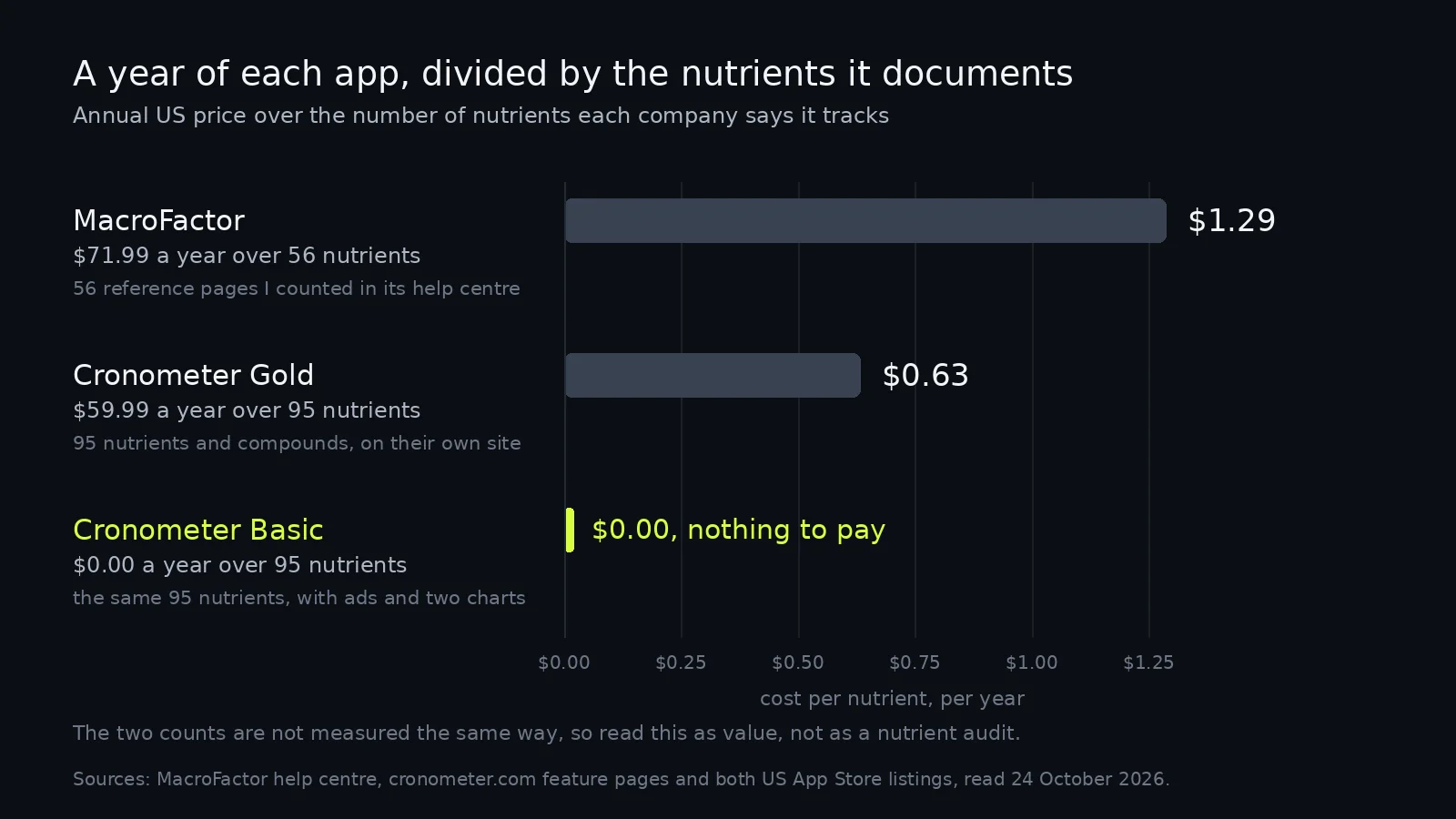
Cronometer Gold is $59.99 a year, MacroFactor $71.99, and only Cronometer has a free tier. Nutrient counts and Apple Health, checked 24 Oct 2026.
On this page
Cronometer Gold costs $59.99 a year against MacroFactor's $71.99, and Cronometer's free tier tracks every nutrient it has while MacroFactor has none at all. MacroFactor is the only one of the two that reads nutrition back out of Apple Health, which is the thing that matters if you ever log in a second app.
I read both help centres and both US App Store listings on 24 October 2026. Every price and feature below comes off those pages.
I build a calorie tracker myself, so treat the last section as the biased one and the rest as what the documents say.
Which one costs less in 2026?
Cronometer Gold at $59.99 a year, against $71.99 for MacroFactor.
Cronometer's US App Store listing shows two Gold purchases, Gold Monthly at $10.99 and Gold Annual at $59.99 (App Store).
MacroFactor's help centre lists $11.99 a month, $47.99 for half a year and $71.99 a year for a single app, and the same three prices appear on its App Store page (MacroFactor).
There is a fourth MacroFactor price. A bundle covering the separate MacroFactor Workouts app is $89.99 a year, and anyone who subscribed before 1 January 2026 keeps Workouts free until 12 January 2027 (MacroFactor).
Is either one actually free?
Only Cronometer, and its free account is not a stub.
A Basic account covers all 95 nutrients, the whole database of over a million entries, unlimited barcode scanning, custom meals and recipes, and device syncing (Cronometer). The limits are the advertising and a seven day window on your nutrition history, with two charts in place of the full library.
Gold buys the ad-free view, long term charts and reports, the Oracle food suggestions, fasting, custom biometrics and the recipe importer (Cronometer support, updated 17 October 2026).
MacroFactor does not do free. Its App Store listing is unusually blunt about it: the app "has a free trial, but does not offer a free subscription tier", and the same listing describes a seven day trial (App Store).
MacroFactor and Cronometer side by side
MacroFactor costs more and hands you every logging method on day one. Cronometer goes deeper on nutrients and lets you stay free forever.
| What people ask | MacroFactor | Cronometer | Source, read 24 Oct 2026 |
|---|---|---|---|
| Cheapest year, US | $71.99 | $59.99 (Gold) | MF, Cron |
| Monthly | $11.99 | $10.99 | MF, Cron |
| Free tier | None, 7 day trial | Basic, no expiry, with ads | MF, Cron |
| Nutrients documented | 56 reference pages | "up to 95 nutrients and compounds" | MF, Cron |
| Barcode scanner | Yes, paid only | Yes, free and unlimited | MF, Cron |
| Spoken or typed meal | Describe, any plan | Voice Logging, Gold only | MF, Cron |
| Photo logging | AI photo, any plan | Photo Logging, Gold only | MF, Cron |
| Siri, app stays closed | Not documented | Yes, Gold only | Cron |
| Reads nutrition from Health | Yes, with a priority rule | Not in its docs | MF, Cron |
| App Store rating | 4.8 from 23K ratings | 4.8 from 100K ratings | MF, Cron |
How many nutrients does each one track?
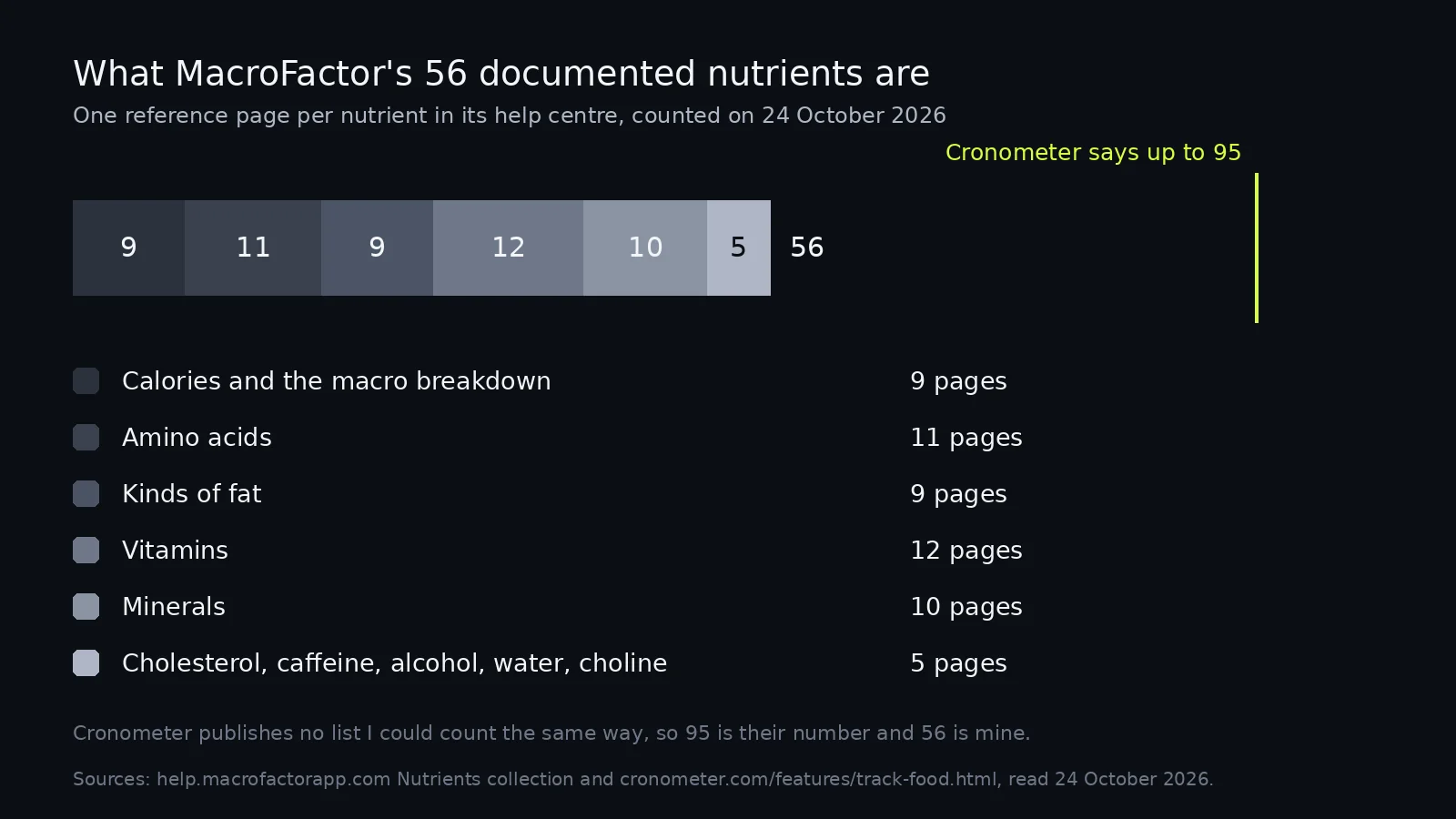
Cronometer says up to 95. MacroFactor's help centre documents 56, and I counted them one page at a time.
MacroFactor publishes a Nutrients collection with one reference article per nutrient it tracks. On 24 October 2026 that collection held 56 articles: 9 on calories and the macro breakdown, 11 amino acids, 9 kinds of fat, 12 vitamins, 10 minerals, and 5 others covering cholesterol, caffeine, alcohol, water and choline (MacroFactor).
Cronometer's Track Food page promises "up to 95 nutrients and compounds" (Cronometer), and its free tier page repeats the 95. Its own home page says 84 in the paragraph about Cronometer Pro, so their marketing does not agree with itself. Either way there is no list I could count, so 95 is their figure and 56 is mine.
Both warn you that the number is a ceiling, not what you will actually see. MacroFactor says most branded products do not report deep micronutrient data, so anything beyond calories, macros and "some major micronutrients" will be undercounted unless you log common foods (MacroFactor).
Cronometer hides some nutrients by default for the same reason, and warns that tracked values "may be significantly lower than they actually are" (Cronometer support, updated 14 August 2026).
So the real question is how many foods in each database carry a full nutrient profile. MacroFactor says 26,500 of roughly 1,360,000 searchable items are micronutrient complete, which is 1.9% (MacroFactor). Cronometer's lab analysed core is the NCC database at over 17,000 entries with data on 70 nutrients, plus USDA SR28 at over 8,000 (Cronometer support, updated 21 October 2026). Its whole database runs past a million entries and it does not say how much of that is lab analysed (Cronometer).
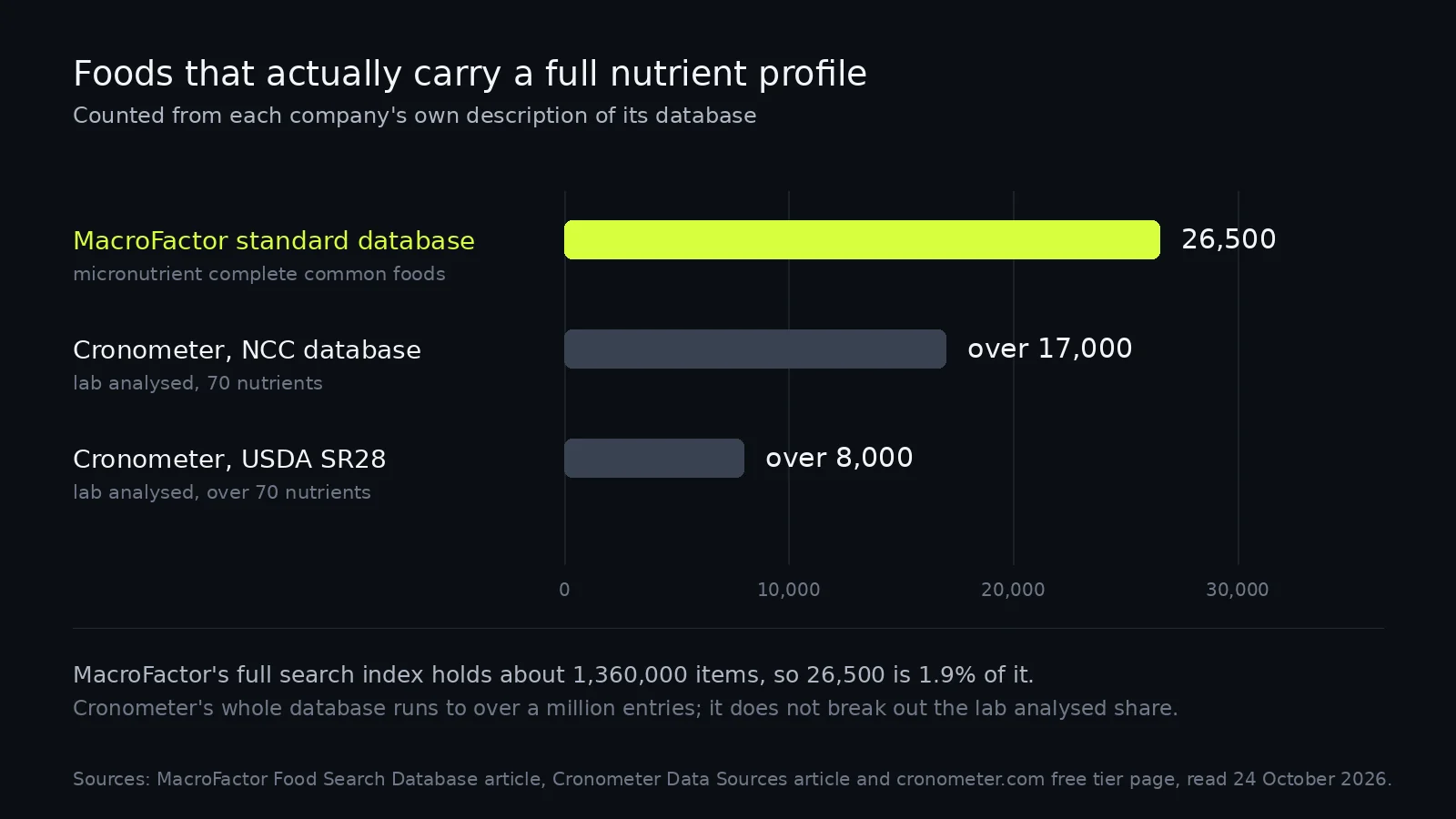
Cronometer does this part better. It also sells a Pro tier aimed at dietitians and research teams, which is not a market MacroFactor is chasing (Cronometer support).
Which one gets your food into Apple Health?
Both write. Only MacroFactor reads nutrition back in.
MacroFactor's integrations page spells out a priority order: manual entry, then its own food log, then Apple Health. A MacroFactor food entry for a day blocks the Health import for that day (MacroFactor).
Cronometer's Apple Health article covers activity, exercise, biometrics and sleep coming in, and tells you to pick read and write permissions, but nothing in it describes importing food logged elsewhere (Cronometer support, updated 22 October 2026).
One thing changed while I was writing. When I read that article on 20 October 2026 for our Apple Health comparison, it named the nutrient fields Cronometer writes. The 22 October version does not, and no other article in their help centre lists them now. Treat the write list as undocumented until they put it back.
Which one should you pick?
Cronometer if you care about micronutrients or want to pay nothing. MacroFactor if you want the coaching algorithm and do not mind the $71.99.
MacroFactor's pitch is its expenditure algorithm, which reads your weight trend against your logged intake and updates your targets. It needs food logged "at least four times per week, but ideally every day" to keep running (MacroFactor).
Cronometer's pitch is depth, and it charges for the fast logging paths; our voice input comparison has the detail on that.
Mine is the third option and the narrow one. You say what you ate and MealSaid writes calories and macros into Apple Health. If you forget, it calls your phone and asks.
It also has no barcode scanner, no food database to search, no Android app, no web app, no vitamins or minerals at all, and it needs iOS 26. If you want 95 nutrients, Cronometer Basic gives you them for nothing. You can read how MealSaid works before deciding.
How I checked this
Checked 24 October 2026. Prices came from the In App Purchases panel on each US App Store listing and from MacroFactor's own subscription article; Apple shows at most ten purchases per listing, so those are floors.
The 56 nutrient count is my own count of the articles in MacroFactor's public Nutrients collection on that date, so it will drift as they add pages. The 95 is Cronometer's claim on two of its own feature pages and I could not verify it item by item. Their home page says 84 for Cronometer Pro, and I did not find any page that reconciles the two.
Cronometer's help centre returns 403 to scripted fetches, so those articles were read through the public help centre API and their "updated" dates are the ones the API reports. Corrections to ohmbrock42@gmail.com.
Questions
Is Cronometer cheaper than MacroFactor?
Yes. Gold Annual is $59.99 and MacroFactor's single app annual plan is $71.99, both read from their US App Store listings on 24 October 2026. Cronometer's free Basic account already tracks every nutrient, so for a lot of people the real gap is the full $71.99.
Does MacroFactor have a free version?
No. Its US App Store listing says it "has a free trial, but does not offer a free subscription tier", and the listing puts that trial at seven days. After that the app stops working without a subscription.
Which tracks more micronutrients, MacroFactor or Cronometer?
Cronometer, on both companies' own numbers. Its Track Food page says up to 95 nutrients and compounds, while MacroFactor's help centre has a reference page for 56, of which 22 are vitamins and minerals.
Does Cronometer import nutrition from Apple Health?
Its Apple Health article covers importing activity, biometrics and sleep, and never describes pulling in food logged by another app. MacroFactor's integration docs do describe that, with a stated priority order.
Can you log a meal by voice in either app?
Both turn a spoken or typed meal description into diary entries. MacroFactor's Describe works on any paid plan, while Cronometer's Voice Logging and its Siri phrase both require Gold.