 MealSaid
How to stay consistent with calorie tracking: 6 rules
Six rules from habit research, with sample sizes. Health habits took a median of 59 to 66 days to feel automatic, and 4 to 335 days across people.
On this page
- What are the six rules?
- How long before logging feels automatic?
- Does it matter when in the day I log?
- Why do reminders stop working?
- Is it better to log everything, or to log something every day?
- How many times a day should I log?
- Where does MealSaid fit, and where does it fail this test?
- How I checked this
Two things in the research move food logging from a chore into something you just do: a fixed event to hang it on, and a low bar for what counts as a day logged. In the one review that pooled the question, health habits took a median of 59 to 66 days to feel automatic, with individual times from 4 to 335 days (Singh et al., Healthcare 2024, 20 studies, 2,601 participants).
The low bar matters more than it sounds. In an 8 week study of 90 adults using a food app, every week with three or more days logged was worth 0.23% of body weight, while recording at least half of your calorie goal predicted nothing at all (Payne et al., 2022).
I read six papers for this on 27 October 2026 and pulled six rules out of them. Where a number comes from a review rather than the original paper, I say so.
What are the six rules?
Hang the log on something you already do early in the day, and keep the bar at three days a week. Each rule below comes from one study, with its sample size.
| Rule | Study and sample | What it measured | What it found |
|---|---|---|---|
| Plan for two months, not three weeks | Singh 2024, review of 20 studies, 2,601 people | Days to reach automaticity | Medians of 59 and 66 days, individuals 4 to 335 |
| Put it in the morning | Fournier 2017, via Singh 2024 | Daily stretching, morning vs evening | Mean 106 days morning, 154 days evening |
| Hang it on the end of a routine you already have | Judah 2013, N = 50 | Flossing before vs after brushing | Flossing after brushing gave stronger habits at 8 months |
| Use the event, not the clock | Stawarz 2015, 4 week study plus 115 apps | Reminders vs event based cues | Reminders gave repetition, event cues gave automaticity |
| Clear three days a week before chasing accuracy | Payne 2022, n = 90, 8 weeks | Consistency vs completeness | 0.23% of weight per consistent week, completeness p = 0.062 |
| Spread it over two or three visits a day | Harvey 2019, n = 142, 24 weeks | Journal visits a day at month six | 2.7 a day for the biggest losers, 1.7 for the rest |
How long before logging feels automatic?
About two months for a typical person, and anywhere from a few days to most of a year for a real one. Most of the useful information is in that spread.
Singh and colleagues searched six databases and found 20 experimental studies covering 2,601 people (Healthcare 2024). Only four of those reported how long a habit took to form.
Keller 2021 put healthy eating habits at a median of 59 days with a range of 4 to 335, and only 23% of participants got there at all. Lally 2010 reported a median of 66 days, Lally 2008 a mean of 91 days, and Fournier 2017 a mean of 106 days for morning stretching against 154 for evening. All four figures come from the 2024 review, which I read in full; I could not open the Lally papers themselves.
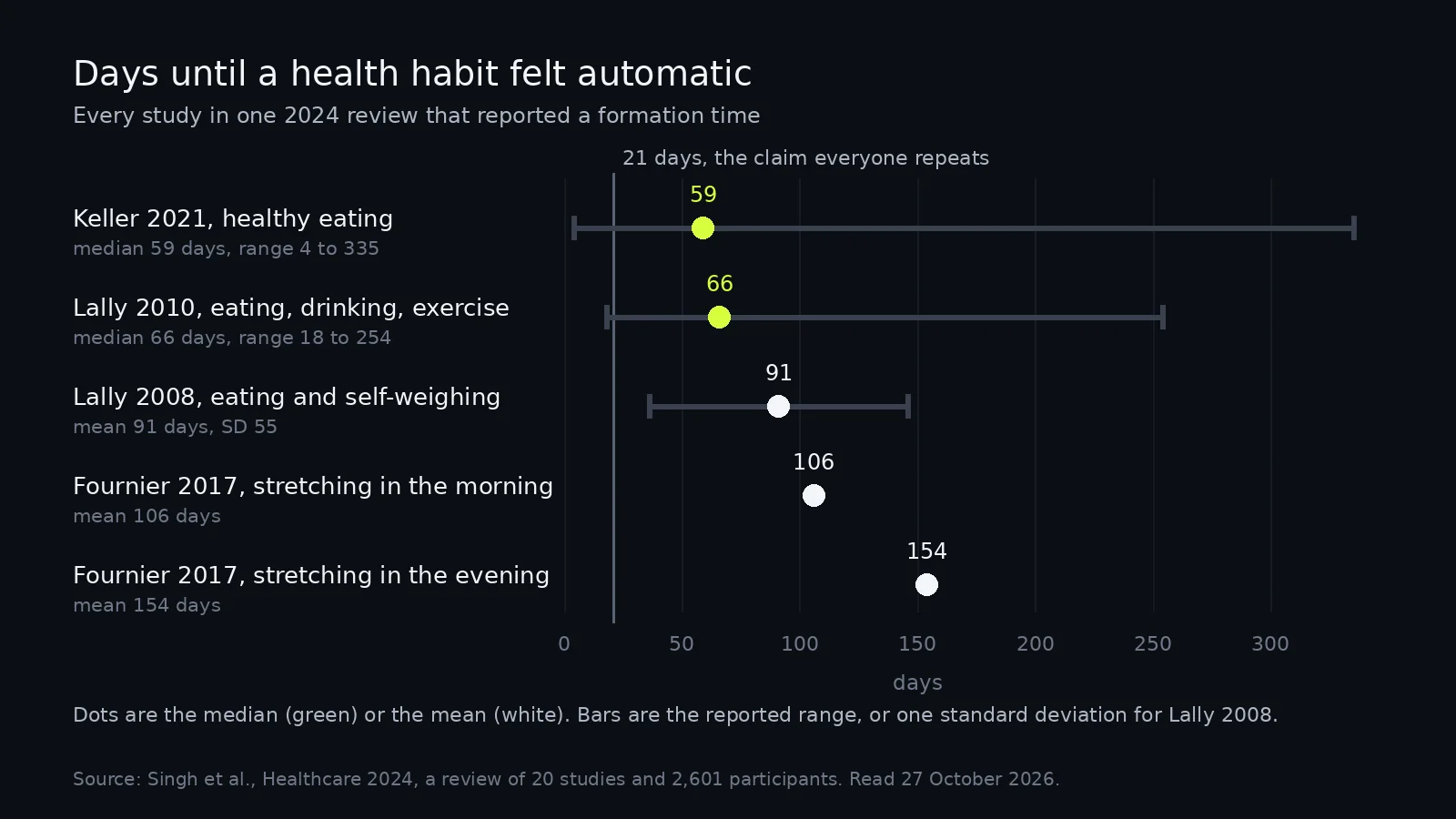
The 21 day figure that every habit article repeats is in none of them.
Does it matter when in the day I log?
Earlier is better, and immediately after something you already do is better still. Two studies point the same way from different behaviours.
Fournier's stretchers took 48 days longer to reach automaticity in the evening than in the morning, as reported in Singh's review. Mornings have fewer competing events, so the cue fires before the day can bury it.
Judah and colleagues gave all 50 participants the same motivational session, then told half to floss before brushing and half after. Those who flossed after brushing had stronger habits and flossed more often at the 8 month follow up (Judah et al., 2013).
So pick the end of an existing routine rather than a time. "After I pour the first coffee" beats "in the morning".
Why do reminders stop working?
Because an alarm trains you to answer the alarm, not to notice the meal. That is the uncomfortable result in the one study that compared the two directly.
Stawarz, Cox and Blandford ran a 4 week cue study and reviewed 115 habit apps for CHI 2015. Reminders supported repetition but "hindered habit development", while "event-based cues led to increased automaticity", and positive reinforcement did nothing (Bristol repository record).
One 4 week study is not a law, and a reminder you act on beats a habit you never form. Our reminder comparison found that at best 19.05% of logging reminders were tapped, which is about what you would expect from a cue with no event attached.
The practical version of an event cue is an if then sentence written in advance. Across 23 eating studies, those plans had a Cohen's d of 0.51 for adding healthy foods and 0.29 for cutting unhealthy ones (Adriaanse et al., Appetite 2011).
Is it better to log everything, or to log something every day?
Something, every few days. Logging roughly on three days a week predicted weight loss; logging your full calorie goal did not.
Payne and colleagues followed 90 employees with overweight or obesity for 8 weeks on Calorie Counter by FatSecret (Obes Sci Pract 2022). They scored three kinds of adherence: frequency, consistency (weeks with three or more days logged) and completeness (weeks recording at least half the calorie goal).
Consistency and frequency both predicted weight change, at 0.23% of body weight per consistent week and 0.02% per extra 1% of days. Completeness missed significance at p = 0.062 (regression results).
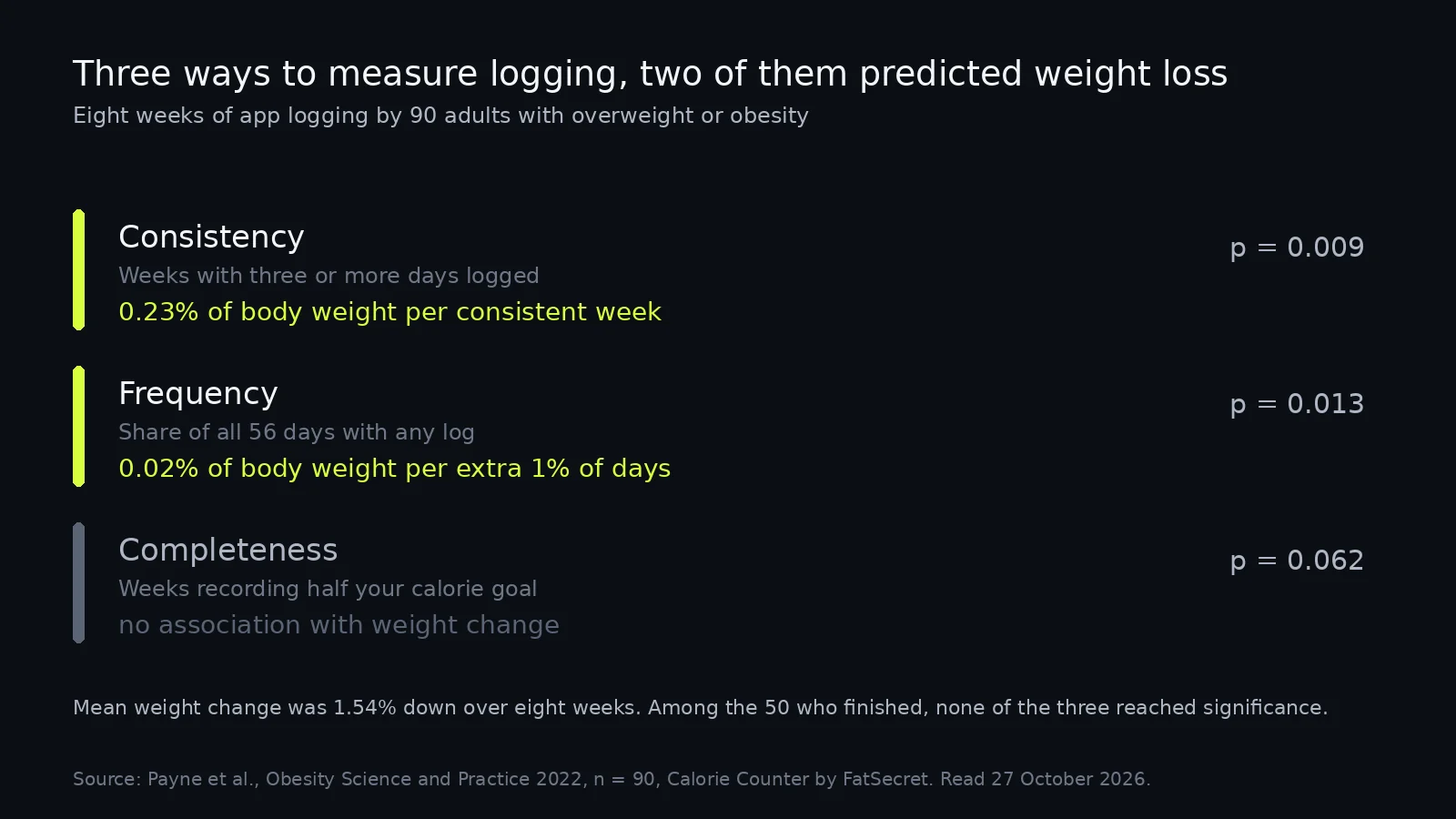
Participants averaged 4.4 consistent weeks out of 8 (Payne 2022). Running their slope out, the gap between 2 consistent weeks and all 8 is 1.38% of body weight, about 1.3 kg at this group's mean weight of 94.9 kg.
Two honest caveats, both from the same paper. Among the 50 people who finished the full 8 weeks, none of the three measures reached significance, and 89% of the sample backlogged at least one day rather than logging it live (results section).
How many times a day should I log?
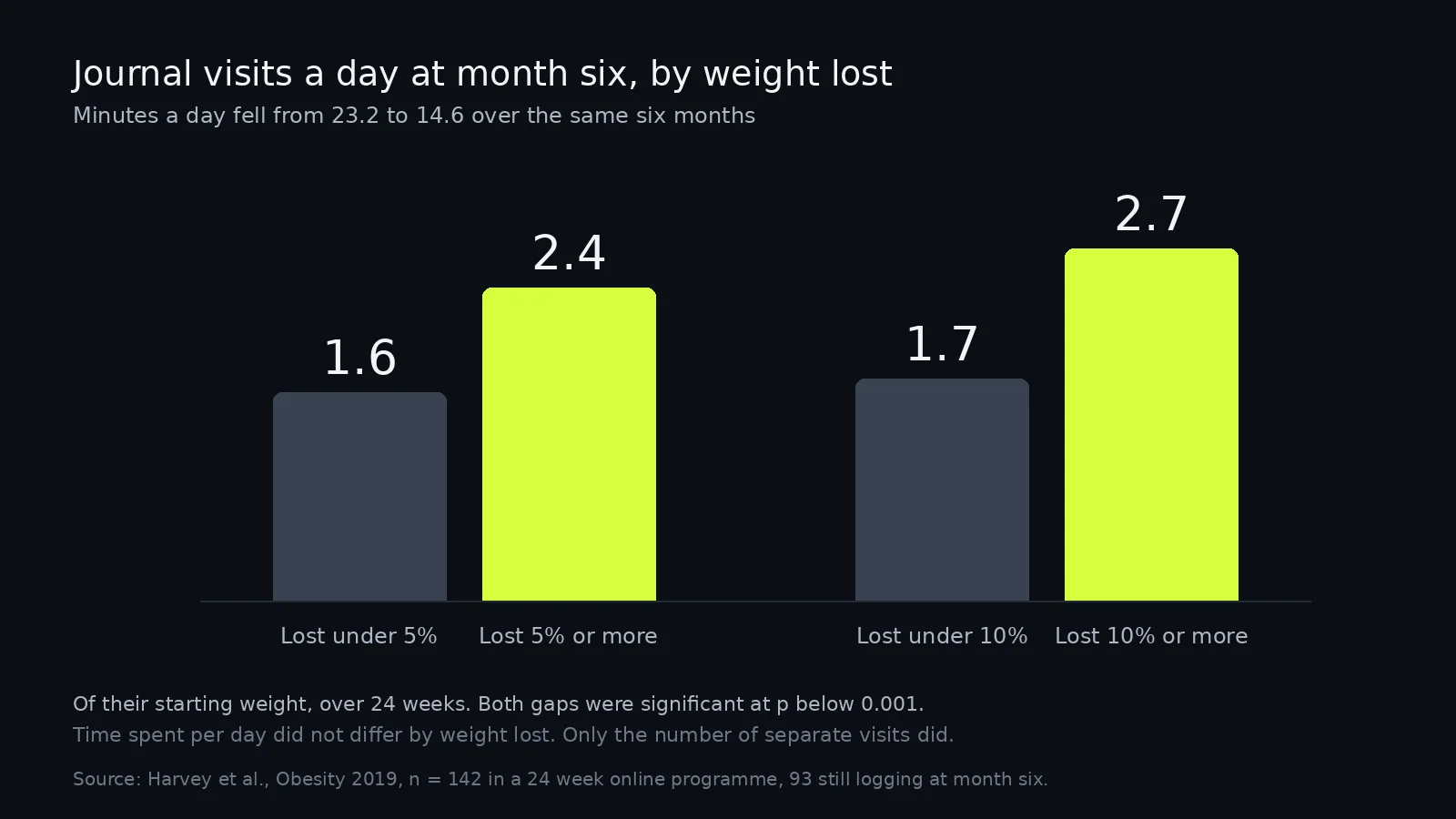
Two or three, in small visits. Minutes spent did not separate the people who lost weight; the number of separate visits did.
Harvey and colleagues tracked 142 people through a 24 week online weight programme. Time spent self monitoring fell from 23.2 minutes a day in month 1 to 18.1 in month 3 and 14.6 in month 6, and 65.5% were still recording anything by then (Obesity 2019).
At month six, those who had lost 5% or more of their weight opened the journal 2.4 times a day against 1.6 for the rest, and the 10% group 2.7 against 1.7, both at p below 0.001 (Harvey et al., Obesity 2019). The authors' own reading is that successful participants logged "at least two to three times a day".
Average those three figures and you get 18.6 minutes a day, which over 24 weeks is about 52 hours of typing. That is the real price of the method, and it is why the effort side matters as much as the cue side.
Where does MealSaid fit, and where does it fail this test?
It cuts the cost of one entry; it does not give you a proper event cue. I built it, so take the second half seriously.
MealSaid calls your phone at times you choose and asks what you ate. That is a clock cue, the exact kind Stawarz found builds repetition rather than automaticity, and I am not going to pretend otherwise.
What it does help with is the three days a week bar. You say the meal in one sentence and it lands in Apple Health, or you say it to Siri with the app closed, which is how you attach a log to a real event like putting the plate in the sink. There is more on the mechanics in how MealSaid works.
It has no barcode scanner, no photo logging, no food database search and no way to import food other apps wrote to Apple Health. It is iPhone only and needs iOS 26. It understands English only. If you want a database you can audit, Cronometer is the better tool and this is not a close call.
For why the quitting happens in the first place, I went through seven dropout studies in why people quit calorie tracking.
How I checked this
Checked 27 October 2026. I read the Singh 2024 review, the Payne 2022 paper and the Harvey 2019 paper in full on PubMed Central, the Judah 2013 abstract on the authors' own repository at LSHTM, the Stawarz 2015 abstract on the University of Bristol research record, and the Adriaanse 2011 abstract through its publisher page.
Four numbers are second hand and labelled as such: the Keller 2021, Lally 2010, Lally 2008 and Fournier 2017 formation times, all taken from Singh's review because the original papers sit behind publisher walls that refuse automated access. The 52 hour figure and the 1.38% gap are my own arithmetic on the published means and regression slopes, not findings from the papers.
Nothing here is from MealSaid's own data. I have not published an adherence study of my own yet. Corrections to ohmbrock42@gmail.com.
Questions
How long does it take for calorie tracking to become a habit?
Plan for about two months, not three weeks. The four studies that measured it reported medians of 59 and 66 days and means of 91 to 154 days, with individual times from 4 to 335 days.
Is it better to log everything accurately or log roughly every day?
Log roughly, often. In an 8 week study of 90 adults each consistent week was worth 0.23% of body weight, and how completely people recorded their calorie goal was not significantly related to weight change.
How many times a day should I log my food?
Two or three. At month six of a 24 week trial, people who had lost 10% or more were opening the journal 2.7 times a day while the rest opened it 1.7 times, and time spent per day did not separate the groups.
What if I miss a day of logging?
The definition of consistency that predicted weight loss was three or more days in a week, not seven. Missed days are built into the measure, so one gap does not undo the week.
Do reminders make you consistent?
They make you repeat the behaviour without making it automatic. A 4 week study found event based cues raised automaticity while reminders did not, so tie the log to something you already do.